Most Read Book in the UK

Most Read Book in the UK

The “most read book” in the UK can be interpreted in different ways, but based on popularity, A Christmas Carol by Charles Dickens is cited as the most read as of a 2024 YouGov poll. However, based on all-time sales and other polls, The Lord of the Rings by J.R.R. Tolkien is often considered the favorite, with the Harry Potter series by J.K. Rowling being the best-selling book series overall. 

By popularity (2024 poll)
  • A Christmas Carol by Charles Dickens was the most popular fiction book, with 68% of adults saying they have read it
By all-time sales and fan favorite
  • The Lord of the Rings by J.R.R. Tolkien was voted the UK’s favorite novel in the BBC’s Big Read poll.
  • The Harry Potter series by J.K. Rowling is the best-selling book series, with titles like Harry Potter and the Philosopher’s Stone frequently topping sales charts. 
Other popular and important books
  • Nineteen Eighty-Four by George Orwell is a classic and a frequent contender for top spots in both popularity and sales lists.
  • To Kill a Mockingbird by Harper Lee remains highly read, partly due to its inclusion in school curriculums. 

A Christmas Carol

A Christmas Carol. In Prose. Being a Ghost Story of Christmas, commonly known as A Christmas Carol, is a novella by Charles Dickens, first published in London by Chapman & Hall in 1843 and illustrated by John Leech. It recounts the story of Ebenezer Scrooge, an elderly miser who is visited by the ghost of his former business partner Jacob Marley and the spirits of Christmas PastPresent and Yet to Come. In the process, Scrooge is transformed into a kinder, gentler man.

A Christmas Carol is consistently one of the most-read books in the UK, having been popular since its first publication in 1843. It is considered a classic and beloved Christmas tale, and the story’s enduring popularity is evident in its many adaptations and continued presence in literature lists and popular culture, note Amazon UK, Penguin Books, and The British Library

  • Immediate success: The novella was an instant success upon its release, with the first print run of 6,000 copies selling out within days.
  • Enduring popularity: A Christmas Carol remains a favorite with families and is frequently re-read during the festive season.
  • Cultural impact: The story is so influential that it is often cited as the most famous Christmas story ever written and has been adapted countless times for stage, screen, and radio.
  • Constant presence: It is a constant feature in lists of classic and festive books, such as those compiled by the BBC and Penguin Books
What A Rose Can Say Poem by Margie Driver

What A Rose Can Say Poem by Margie Driver

A rose can say I love you and want you to be mine,
A rose can say I thank you for being so very kind,
A rose can say congratulations, whatever the occasion may be,
A rose can say I miss you and wish you were here with me,
A rose can say I’m sorry if I’ve hurt you in any way,
A rose can say get well soon, May God bless you today,
A rose can say I wish you happiness, and the best for you each day.
A rose can say farewel when someone goes away,
A rose can say hello, I’m thinking of you today,
There’s just so many wonderful things that a rose can say,
A rose can say goodbye when a love one is laid to rest,
No matter what there is to say, a rose can say it best.

Cross Poem by Langston Hughes

Cross Poem by Langston Hughes

My old man’s a white old man
And my old mother’s black.
If ever I cursed my white old man
I take my curses back.
If ever I cursed my black old mother
And wished she were in hell,
I’m sorry for that evil wish
And now I wish her well
My old man died in a fine big house.
My ma died in a shack.
I wonder where I’m going to die,
Being neither white nor black?

I Do Not Love You Except Because I Love You Poem by Pablo Neruda

I Do Not Love You Except Because I Love You Poem by Pablo Neruda

I do not love you except because I love you;
I go from loving to not loving you,
From waiting to not waiting for you
My heart moves from cold to fire.

I love you only because it’s you the one I love;
I hate you deeply, and hating you
Bend to you, and the measure of my changing love for you
Is that I do not see you but love you blindly.

Maybe January light will consume
My heart with its cruel
Ray, stealing my key to true calm.

In this part of the story I am the one who
Dies, the only one, and I will die of love because I love you,
Because I love you, Love, in fire and blood.

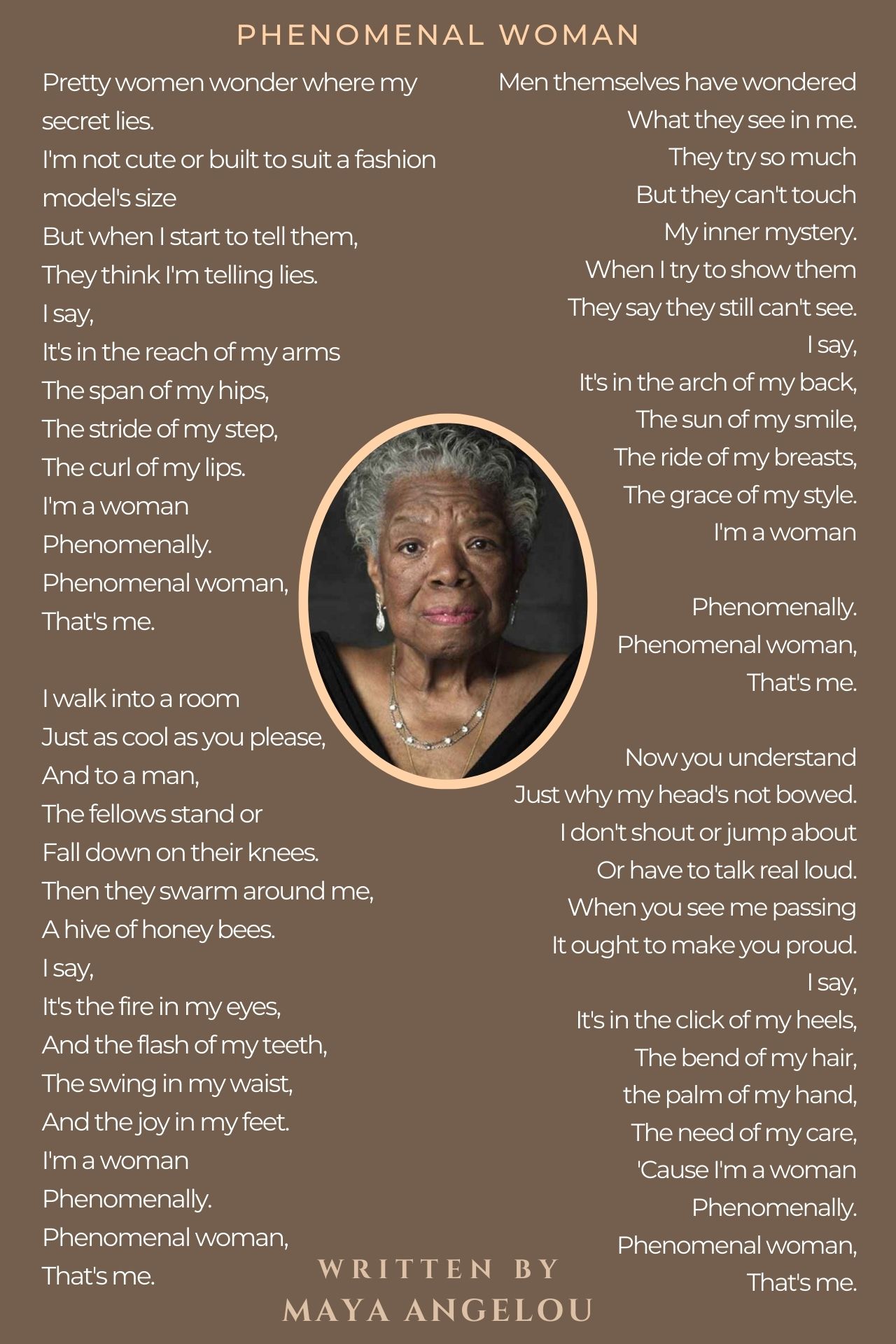
Phenomenal Woman Poem by Maya Angelou

Phenomenal Woman Poem by Maya Angelou

Pretty women wonder where my secret lies.
I’m not cute or built to suit a fashion model’s size
But when I start to tell them,
They think I’m telling lies.
I say,
It’s in the reach of my arms
The span of my hips,
The stride of my step,
The curl of my lips.
I’m a woman
Phenomenally.
Phenomenal woman,
That’s me.

I walk into a room
Just as cool as you please,
And to a man,
The fellows stand or
Fall down on their knees.
Then they swarm around me,
A hive of honey bees.
I say,
It’s the fire in my eyes,
And the flash of my teeth,
The swing in my waist,
And the joy in my feet.
I’m a woman
Phenomenally.
Phenomenal woman,
That’s me.

Men themselves have wondered
What they see in me.
They try so much
But they can’t touch
My inner mystery.
When I try to show them
They say they still can’t see.
I say,
It’s in the arch of my back,
The sun of my smile,
The ride of my breasts,
The grace of my style.
I’m a woman

Phenomenally.
Phenomenal woman,
That’s me.

Now you understand
Just why my head’s not bowed.
I don’t shout or jump about
Or have to talk real loud.
When you see me passing
It ought to make you proud.
I say,
It’s in the click of my heels,
The bend of my hair,
the palm of my hand,
The need of my care,
‘Cause I’m a woman
Phenomenally.
Phenomenal woman,
That’s me.

New Year by Bei Dao

New Year by Bei Dao

New Year By Bei Dao
a child carrying flowers walks toward the new year
a conductor tattooing darkness
listens to the shortest pause
hurry a lion into the cage of music
hurry stone to masquerade as a recluse
moving in parallel nights
who’s the visitor? when the days all
tip from nests and fly down roads
the book of failure grows boundless and deep
each and every moment’s a shortcut
I follow it through the meaning of the East
returning home, closing death’s door
Orpheus, Eurydice, Hermes

Orpheus, Eurydice, Hermes

This was the eerie mine of souls.
Like silent silver-ore
they veined its darkness. Between roots
the blood that flows off into humans welled up,
looking dense as porphyry in the dark.
Otherwise, there was no red.

There were cliffs
and unreal forests. Bridges spanning emptiness
and that huge gray blind pool
hanging above its distant floor
like a stormy sky over a landscape.
And between still gentle fields
a pale strip of road unwound.

They came along this road.

In front the slender man in the blue cloak,
mute, impatient, looking straight ahead.
Without chewing, his footsteps ate the road
in big bites; and both his hands hung
heavy and clenched by the pour of his garment
and forgot all about the light lyre,
become like a part of his left hand,
rose tendrils strung in the limbs of an olive.
His mind like two minds.
While his gaze ran ahead, like a dog,
turned, and always came back from the distance
to wait at the next bend–
his hearing stayed close, like a scent.
At times it seemed to reach all the way back
to the movements of the two others
who ought to be following the whole way up.
And sometimes it seemed there was nothing behind him
but the echo of his own steps, the small wind
made by his cloak. And yet
he told himself: they were coming, once;
said it out loud, heard it die away . . .
They were coming. Only they were two
who moved with terrible stillness. Had he been allowed
to turn around just once (wouldn’t that look back
mean the disintegration of this whole work,
still to be accomplished) of course he would have seen them,
two dim figures walking silently behind:

the god of journeys and secret tidings,
shining eyes inside the traveler’s hood,
the slender wand held out in front of him,
and wings beating in his ankles;
and his left hand held out to: her.

This woman who was loved so much, that from one lyre
more mourning came than from women in mourning;
that a whole world was made from mourning, where
everything was present once again: forest and valley
and road and village, field, river and animal;
and that around this mourning-world, just as
around the other earth, a sun
and a silent star-filled sky wheeled,
a mourning-sky with displaced constellations–:
this woman who was loved so much . . .

But she walked alone, holding the god’s hand,
her footsteps hindered by her long graveclothes,
faltering, gentle, and without impatience.
She was inside herself, like a great hope,
and never thought of the man who walked ahead
or the road that climbed back toward life.
She was inside herself. And her being dead
filled her like tremendous depth.
As a fruit is filled with its sweetness and darkness
she was filled with her big death, still so new
that it hadn’t been fathomed.

She found herself in a resurrected
virginity; her sex closed
like a young flower at nightfall.
And her hands were so weaned from marriage
that she suffered from the light
god’s endlessly still guiding touch
as from too great an intimacy.

She was no longer the blond woman
who sometimes echoed in the poet’s songs,
no longer the fragrance, the island of their wide bed,
and no longer the man’s to possess.

She was already loosened like long hair
and surrendered like the rain
and issued like massive provisions.
She was already root.

And when all at once the god stopped
her, and with pain in his voice
spoke the words: he has turned around–,
she couldn’t grasp this and quietly said: who?

But far off, in front of the bright door
stood someone whose face
had grown unrecognizable. He just stood and watched,
how on this strip of road through the field
the god of secret tidings, with a heartbroken expression,
silently turned to follow the form
already starting back along the same road,
footsteps hindered by long graveclothes,
faltering, gentle, and without impatience.

Aubade by Philip Larkin

Aubade by Philip Larkin

Aubade
I work all day, and get half-drunk at night.   
Waking at four to soundless dark, I stare.   
In time the curtain-edges will grow light.   
Till then I see what’s really always there:   
Unresting death, a whole day nearer now,   
Making all thought impossible but how   
And where and when I shall myself die.   
Arid interrogation: yet the dread
Of dying, and being dead,
Flashes afresh to hold and horrify.
The mind blanks at the glare. Not in remorse   
—The good not done, the love not given, time   
Torn off unused—nor wretchedly because   
An only life can take so long to climb
Clear of its wrong beginnings, and may never;   
But at the total emptiness for ever,
The sure extinction that we travel to
And shall be lost in always. Not to be here,   
Not to be anywhere,
And soon; nothing more terrible, nothing more true.
This is a special way of being afraid
No trick dispels. Religion used to try,
That vast moth-eaten musical brocade
Created to pretend we never die,
And specious stuff that says No rational being
Can fear a thing it will not feel, not seeing
That this is what we fear—no sight, no sound,   
No touch or taste or smell, nothing to think with,   
Nothing to love or link with,
The anaesthetic from which none come round.
And so it stays just on the edge of vision,   
A small unfocused blur, a standing chill   
That slows each impulse down to indecision.   
Most things may never happen: this one will,   
And realisation of it rages out
In furnace-fear when we are caught without   
People or drink. Courage is no good:
It means not scaring others. Being brave   
Lets no one off the grave.
Death is no different whined at than withstood.
Slowly light strengthens, and the room takes shape.   
It stands plain as a wardrobe, what we know,   
Have always known, know that we can’t escape,   
Yet can’t accept. One side will have to go.
Meanwhile telephones crouch, getting ready to ring   
In locked-up offices, and all the uncaring
Intricate rented world begins to rouse.
The sky is white as clay, with no sun.
Work has to be done.
Postmen like doctors go from house to house.
Character of the Happy Warrior

Character of the Happy Warrior

Character of the Happy Warrior
  Who is the happy Warrior? Who is he
That every man in arms should wish to be?
—It is the generous Spirit, who, when brought
Among the tasks of real life, hath wrought
Upon the plan that pleased his boyish thought:
Whose high endeavours are an inward light
That makes the path before him always bright;
Who, with a natural instinct to discern
What knowledge can perform, is diligent to learn;
Abides by this resolve, and stops not there,
But makes his moral being his prime care;
Who, doomed to go in company with Pain,
And Fear, and Bloodshed, miserable train!
Turns his necessity to glorious gain;
In face of these doth exercise a power
Which is our human nature’s highest dower:
Controls them and subdues, transmutes, bereaves
Of their bad influence, and their good receives:
By objects, which might force the soul to abate
Her feeling, rendered more compassionate;
Is placable—because occasions rise
So often that demand such sacrifice;
More skilful in self-knowledge, even more pure,
As tempted more; more able to endure,
As more exposed to suffering and distress;
Thence, also, more alive to tenderness.
—’Tis he whose law is reason; who depends
Upon that law as on the best of friends;
Whence, in a state where men are tempted still
To evil for a guard against worse ill,
And what in quality or act is best
Doth seldom on a right foundation rest,
He labours good on good to fix, and owes
To virtue every triumph that he knows:
—Who, if he rise to station of command,
Rises by open means; and there will stand
On honourable terms, or else retire,
And in himself possess his own desire;
Who comprehends his trust, and to the same
Keeps faithful with a singleness of aim;
And therefore does not stoop, nor lie in wait
For wealth, or honours, or for worldly state;
Whom they must follow; on whose head must fall,
Like showers of manna, if they come at all:
Whose powers shed round him in the common strife,
Or mild concerns of ordinary life,
A constant influence, a peculiar grace;
But who, if he be called upon to face
Some awful moment to which Heaven has joined
Great issues, good or bad for human kind,
Is happy as a Lover; and attired
With sudden brightness, like a Man inspired;
And, through the heat of conflict, keeps the law
In calmness made, and sees what he foresaw;
Or if an unexpected call succeed,
Come when it will, is equal to the need:
—He who, though thus endued as with a sense
And faculty for storm and turbulence,
Is yet a Soul whose master-bias leans
To homefelt pleasures and to gentle scenes;
Sweet images! which, wheresoe’er he be,
Are at his heart; and such fidelity
It is his darling passion to approve;
More brave for this, that he hath much to love:—
‘Tis, finally, the Man, who, lifted high,
Conspicuous object in a Nation’s eye,
Or left unthought-of in obscurity,—
Who, with a toward or untoward lot,
Prosperous or adverse, to his wish or not—
Plays, in the many games of life, that one
Where what he most doth value must be won:
Whom neither shape or danger can dismay,
Nor thought of tender happiness betray;
Who, not content that former worth stand fast,
Looks forward, persevering to the last,
From well to better, daily self-surpast:
Who, whether praise of him must walk the earth
For ever, and to noble deeds give birth,
Or he must fall, to sleep without his fame,
And leave a dead unprofitable name—
Finds comfort in himself and in his cause;
And, while the mortal mist is gathering, draws
His breath in confidence of Heaven’s applause:
This is the happy Warrior; this is he
That every man in arms should wish to be.
An Exequy by Peter Porter

An Exequy by Peter Porter

Peter Porter
1929-2010


“An Exequy”


In wet May, in the months of change,
In a country you wouldn’t visit, strange
Dreams pursue me in my sleep,
Black creatures of the upper deep –
Though you are five months dead, I see
You in guilt’s iconography,
Dear Wife, lost beast, beleaguered child,
The stranded monster with the mild
Appearance, whom small waves tease,
(Andromeda upon her knees
In orthodox deliverance)
And you alone of pure substance,
The unformed form of life, the earth
Which Piero’s brushes brought to birth
For all to greet as myth, a thing
Out of the box of imagining.

This introduction serves to sing
Your mortal death as Bishop King
Once hymned in tetrametric rhyme
His young wife, lost before her time;
Though he lived on for many years
His poem each day fed new tears
To that unreaching spot, her grave,
His lines a baroque architrave
The Sunday poor with bottled flowers
Would by-pass in their morning hours,
Esteeming ragged natural life
(‘Most dear loved, most gentle wife’),
Yet, looking back when at the gate
And seeing grief in formal state
Upon a sculpted angel group,
Were glad that men of god could stoop
To give the dead a public stance
And freeze them in their mortal dance.

The words and faces proper to
My misery are private – you
Would never share our heart with those
Whose only talent’s to suppose,
Nor from your final childish bed
Raise a remote confessing head –
The channels of our lives are blocked,
The hand is stopped upon the clock,
No one can say why hearts will break
And marriages are all opaque:
A map of loss, some posted cards,
The living house reduced to shards,
The abstract hell of memory,
The pointlessness of poetry –
These are the instances which tell
Of something which I know full well,
I owe a death to you – one day
The time will come for me to pay
When your slim shape from photographs
Stands at my door and gently asks
If I have any work to do
Or will I come to bed with you.
O scala enigmata,
I’ll climb up to that attic where
The curtain of your life was drawn
Some time between despair and dawn –
I’ll never know with what halt steps
You mounted to this plain eclipse
But each stair now will station me
A black responsibility
And point me to that shut-down room,
‘This be your due appointed tomb.’

I think of us in Italy:
Gin-and-chianti-fuelled, we
Move in a trance through Paradise,
Feeding at last our starving eyes,
Two people of the English blindness
Doing each masterpiece the kindness
Of discovering it – from Baldovinetti
To Venice’s most obscure jetty.
A true unfortunate traveller, I
Depend upon your nurse’s eye
To pick the altars where no Grinner
Puts us off our tourists’ dinner
And in hotels to bandy words
With Genevan girls and talking birds,
To wear your feet out following me
To night’s end and true amity,
And call my rational fear of flying
A paradigm of Holy Dying –
And, oh my love, I wish you were
Once more with me, at night somewhere
In narrow streets applauding wines,
The moon above the Apennines
As large as logic and the stars,
Most middle-aged of avatars,
As bright as when they shone for truth
Upon untried and avid youth.

The rooms and days we wandered through
Shrink in my mind to one – there you
Lie quite absorbed by peace – the calm
Which life could not provide is balm
In death. Unseen by me, you look
Past bed and stairs and half-read book
Eternally upon your home,
The end of pain, the left alone.
I have no friend, no intercessor,
No psychopomp or true confessor
But only you who know my heart
In every cramped and devious part –
Then take my hand and lead me out,
The sky is overcast by doubt,
The time has come, I listen for
Your words of comfort at the door,
O guide me through the shoals of fear –
‘Fürchte dich nicht, ich bin bei dir.’

(from The Cost of Seriousness, 1978)

Pin It on Pinterest