We, unaccustomed to courage exiles from delight live coiled in shells of loneliness until love leaves its high holy temple and comes into our sight to liberate us into life.
Love arrives and in its train come ecstasies old memories of pleasure ancient histories of pain. Yet if we are bold, love strikes away the chains of fear from our souls.
We are weaned from our timidity In the flush of love’s light we dare be brave And suddenly we see that love costs all we are and will ever be. Yet it is only love which sets us free.
Maya Angelou was an American memoirist, essayist, poet, and civil rights activist. She published seven autobiographies, three books of essays, several books of poetry, and is credited with a list of plays, movies, and television shows spanning over 50 years
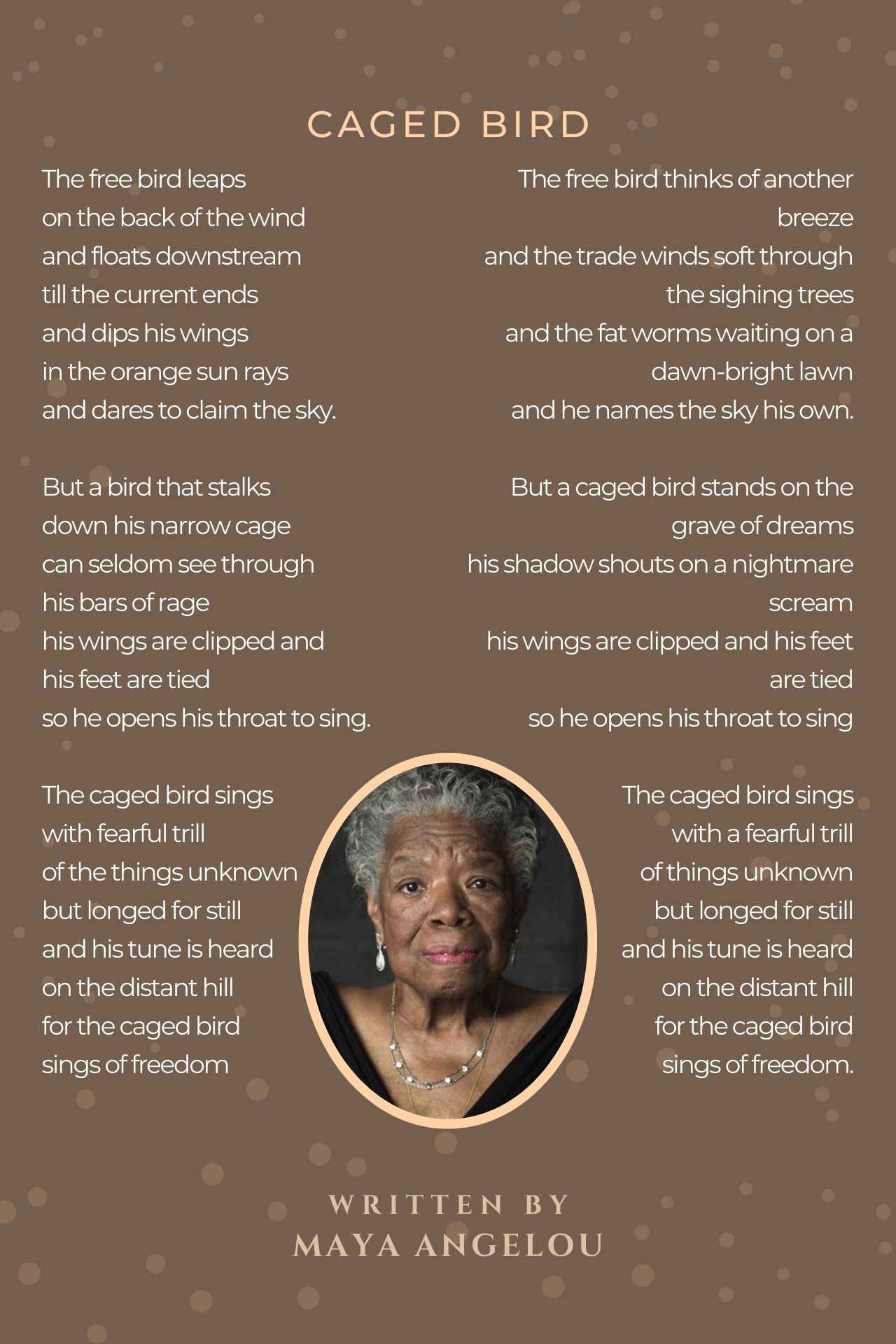
The free bird leaps on the back of the wind and floats downstream till the current ends and dips his wings in the orange sun rays and dares to claim the sky.
But a bird that stalks down his narrow cage can seldom see through his bars of rage his wings are clipped and his feet are tied so he opens his throat to sing.
The caged bird sings with fearful trill of the things unknown but longed for still and his tune is heard on the distant hill for the caged bird sings of freedom
The free bird thinks of another breeze and the trade winds soft through the sighing trees and the fat worms waiting on a dawn-bright lawn and he names the sky his own.
But a caged bird stands on the grave of dreams his shadow shouts on a nightmare scream his wings are clipped and his feet are tied so he opens his throat to sing
The caged bird sings with a fearful trill of things unknown but longed for still and his tune is heard on the distant hill for the caged bird sings of freedom.
Maya Angelou was an American memoirist, essayist, poet, and civil rights activist. She published seven autobiographies, three books of essays, several books of poetry, and is credited with a list of plays, movies, and television shows spanning over 50 years
O, from what power hast thou this powerful might With insufficiency my heart to sway? To make me give the lie to my true sight? And swear that brightness doth not grace the day? Whence hast thou this becoming of things ill, That in the very refuse of thy deeds There is such strength and warranties of skill That, in my mind, thy worst all best exceeds? Who taught thee how to make me love thee more The more I hear and see just cause of hate? O, though I love what others do abhor, With others thou shouldst not abhor my state: If thy unworthiness raised love in me, More worthy I to be beloved of thee.
About
William Shakespeare was an English playwright, poet and actor. He is widely regarded as the greatest writer in the English language and the world’s pre-eminent dramatist
Canst thou, O cruel! say I love thee not, When I against myself with thee partake? Do I not think on thee, when I forgot Am of myself, all tyrant, for thy sake? Who hateth thee that I do call my friend? On whom frown’st thou that I do fawn upon? Nay, if thou lour’st on me, do I not spend Revenge upon myself with present moan? What merit do I in myself respect, That is so proud thy service to despise, When all my best doth worship thy defect, Commanded by the motion of thine eyes? But, love, hate on, for now I know thy mind; Those that can see thou lovest, and I am blind.
About
William Shakespeare was an English playwright, poet and actor. He is widely regarded as the greatest writer in the English language and the world’s pre-eminent dramatist
Love is too young to know what conscience is; Yet who knows not conscience is born of love? Then, gentle cheater, urge not my amiss, Lest guilty of my faults thy sweet self prove: For, thou betraying me, I do betray My nobler part to my gross body’s treason; My soul doth tell my body that he may Triumph in love; flesh stays no farther reason; But, rising at thy name, doth point out thee As his triumphant prize. Proud of this pride, He is contented thy poor drudge to be, To stand in thy affairs, fall by thy side. No want of conscience hold it that I call Her ‘love’ for whose dear love I rise and fall.
About
William Shakespeare was an English playwright, poet and actor. He is widely regarded as the greatest writer in the English language and the world’s pre-eminent dramatist