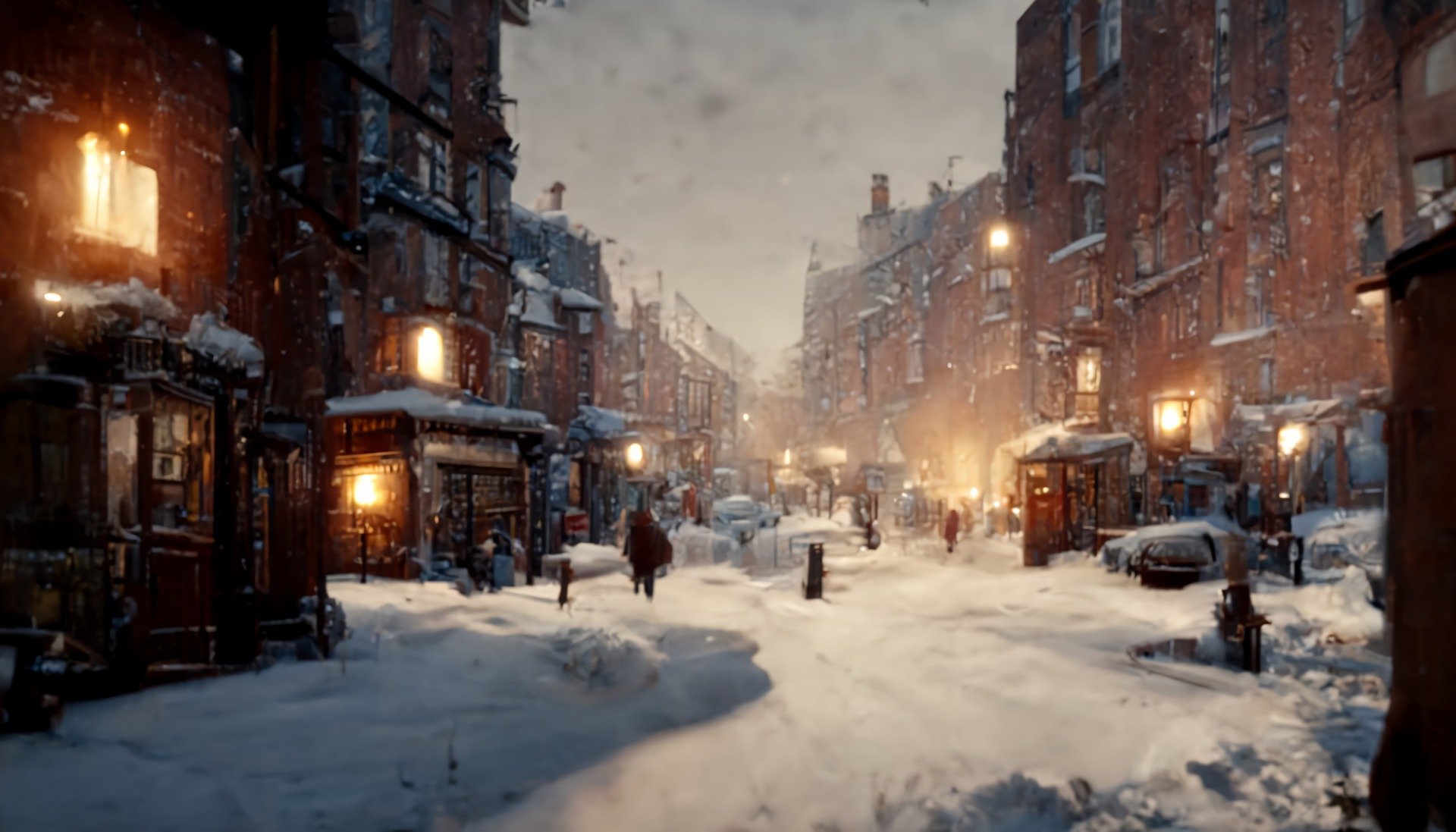
WALKING IN SNOW
What did they say?
Walking the length of a long country, what, a hundred and twenty years ago,
what did they foresee?
As they ploughed on for months along tracks, through fields of snow
did they think We can change the world?
What we can’t hear…it’s always about that, isn’t it.
I’m back in the Nineties
travelling in the far mountains.
I hide in a diner as
snow gathers in the sky.
The server in her neon tiara
lays the plate in front of me, the mug of coffee.
I say Thanks and she says You Betcha.
Behind me a businessman whines into his cell
It’s morally wrong on every level.
Love one another, says my young self.
And yes, love was made, one way or another.
All those years ago we photographed each other naked in the snow.
He held her hand to the end.
Re-education’s the thing nowadays.
Snow drifts in on the north wind,
complete and unabridged.
There he is, the young idealist, some say revolutionary preacher.
Yes, you can see it can’t you, the beard, the odd hat.
And the servants stand outside in the snow
waiting for a prestigious arrival
as the Countess, Bubbles to her friends,
by the roaring fire tells her companion
These things were treated as eccentricities in our day.
You could even read Waugh’s biography of Campion
without anyone calling you perverse.
As to sex, well you did as you liked.
The film shows it now, you can almost feel it.
Why does a paragraph turn blue? Why don’t I understand the way cold works?
And way out in the middle of a ruined, frozen city a boy –
happens, he was autistic but that’s by the by –
dies in the rush and crush
as food is dropped for the trapped and starving.
And somewhere in the future they play Feed The World on giant screens.
Meanwhile a slice of Queen Victoria’s wedding cake sells for two thousand pounds.
And a ballet dancer is the latest to fall out of a window.
In an unremembered village the peasants,
described in newspapers as well-formed, hold
a ceremony in honour of Nadezhda,
who died the day after her seventieth birthday.
Poison in her cake, or so they said.
I still see them all, those young men about to die,
sitting in the back yard, talking, smoking, drinking a little,
slowly, very slowly, getting sozzled.
One, that one there, forever smiling, shot in the head.
His mother will keep his letters, written in pencil.
And that one will walk a thousand miles through snow and ice
to be fenced in and forced to live on what can be scavenged.
When they let him out he’ll be so old his family won’t know him.
Meanwhile, Juniper, the errant son, will catch the train to Cambridge,
take a long, brooding walk in the snow,
wallowing in the misery of parental disapproval
and the consequent shortage of hard cash.
The marriage is delayed while the families thrash out the financial deal,
explains the earl just before the coach overturns on the icy road.
We’ll go on discovering stone circles for centuries yet.
And I watch you tie your hair into bunches.
You are so beautiful. Honestly,
I could just sit and look at you for hours.
The next president, or the one after that, could kill us all.
And you hum a pop song, satisfied your hair will hold.
If we ignore the powerful, or those who would be powerful, if we refuse to say their names, refuse to hear them, to hear of them, to remember them, then it will be the start of the revolution.
And Grandad asks the doctor: Have I got cancer because I smoke?
And the doctor says: Good grief, man, I smoke sixty a day and I’m fit as a fiddle.
Still in his tweed three-piece,
amazed by the intrusion,
the denounced marquess
reaches for the quince jelly, howls
What are we convicted of?
What did we do that upset you
aside from take the waters at Marienbad
and pay a discreet visit or two to La Chabanais?
It was the drink that did for him
explains his brother, as he issues the order
for the young men to run across open ground.
I can still smell the bonfires, jacket potatoes, mugs of hot chocolate.
And my brothers laughing and messing around with fireworks.
They bought paper bags full of bangers and jumping-jacks for pennies.
There was an advert on the side of a wall then. It said:
Enjoy A Confident Laugh With Drinkwater’s Denture Repairs
I didn’t fit in, as you see. My mind was always wandering off.
And eventually my body followed.
My nerves would go as soon as there was any kind of a gathering.
I’d have been useless, just another coward.
Until I met you, that is. You made me brave.
The children skid and slide all the way to school.
A hooded man delivers leaflets as the snow drifts over his shins.
We are not, never were, their sort, I’m glad to say.
Even in the snow
when we were paid to pull early garlic,
we had each other.
We put hot stones inside our gloves.
It’s silly but I talk as if you were still here.
Don’t go into work today.
Stay at home.
There’s not enough time.
And as always out there among the unsafe
the politics of rhetoric outweighs the politics of reason.
And out there, far away but not so far, the next great repression.
It’s beginning, look.
Thousands of women arrested
for not wearing their clothes as lunatics demand.
They can’t stop the snow, though.
Let’s take what we can from that.
There’s only so much they can do
when the blizzard fills the sky.
His wife, once the joy of his life,
with whom he walked
a whole country,
is gone
to everyone but him.
He finds a station,
not interested in coming back
even though he knows
trains won’t run
in this weather.
His soul was a homeless ghost
records his biographer
many years from now
in a book that won’t sell.
The biographer ignores
one of his last diary entries:
Emptiness can be achieved,
or can be cast aside.
I must have been about fifty
when I became an illusion.
Days go slowly for the lucky but go all the same.
Outside, children chatter and laugh
as they study online a topic entitled
Great Snowfalls Of The Past.
And there’s the man – honestly, I know
you won’t recognise him but it is him –
exhausted by memory,
as the snow thickens and freezes.
He sits by the river, watches the water flow.
The past one way, the future the other.
Everywhere I left, he says, I left in shame.