A Rock, A River, A Tree
Hosts to species long since departed,
Mark the mastodon.
The dinosaur, who left dry tokens
Of their sojourn here
On our planet floor,
Any broad alarm of their of their hastening doom
Is lost in the gloom of dust and ages.
But today, the Rock cries out to us, clearly, forcefully,
Come, you may stand upon my
Back and face your distant destiny,
But seek no haven in my shadow.
I will give you no hiding place down here.
You, created only a little lower than
The angels, have crouched too long in
The bruising darkness,
Have lain too long
Face down in ignorance.
Your mouths spelling words
Armed for slaughter.
The rock cries out today, you may stand on me,
But do not hide your face.
Across the wall of the world,
A river sings a beautiful song,
Come rest here by my side.
Each of you a bordered country,
Delicate and strangely made proud,
Yet thrusting perpetually under siege.
Your armed struggles for profit
Have left collars of waste upon
My shore, currents of debris upon my breast.
Yet, today I call you to my riverside,
If you will study war no more.
Come, clad in peace and I will sing the songs
The Creator gave to me when I
And the tree and stone were one.
Before cynicism was a bloody sear across your brow
And when you yet knew you still knew nothing.
The river sings and sings on.
There is a true yearning to respond to
The singing river and the wise rock.
So say the Asian, the Hispanic, the Jew,
The African and Native American, the Sioux,
The Catholic, the Muslim, the French, the Greek,
The Irish, the Rabbi, the Priest, the Sheikh,
The Gay, the Straight, the Preacher,
The privileged, the homeless, the teacher.
They hear. They all hear
The speaking of the tree.
Today, the first and last of every tree
Speaks to humankind. Come to me, here beside the river.
Plant yourself beside me, here beside the river.
Each of you, descendant of some passed on
Traveller, has been paid for.
You, who gave me my first name,
You Pawnee, Apache and Seneca,
You Cherokee Nation, who rested with me,
Then forced on bloody feet,
Left me to the employment of other seekers--
Desperate for gain, starving for gold.
You, the Turk, the Swede, the German, the Scot...
You the Ashanti, the Yoruba, the Kru,
Bought, sold, stolen, arriving on a nightmare
Praying for a dream.
Here, root yourselves beside me.
I am the tree planted by the river,
Which will not be moved.
I, the rock, I the river, I the tree
I am yours--your passages have been paid.
Lift up your faces, you have a piercing need
For this bright morning dawning for you.
History, despite its wrenching pain,
Cannot be unlived, and if faced with courage,
Need not be lived again.
Lift up your eyes upon
The day breaking for you.
Give birth again
To the dream.
Women, children, men,
Take it into the palms of your hands.
Mold it into the shape of your most
Private need. Sculpt it into
The image of your most public self.
Lift up your hearts.
Each new hour holds new chances
For new beginnings.
Do not be wedded forever
To fear, yoked eternally
To brutishness.
The horizon leans forward,
Offering you space to place new steps of change.
Here, on the pulse of this fine day
You may have the courage
To look up and out upon me,
The rock, the river, the tree, your country.
No less to Midas than the mendicant.
No less to you now than the mastodon then.
Here on the pulse of this new day
You may have the grace to look up and out
And into your sister's eyes,
Into your brother's face, your country
And say simply
Very simply
With hope
Good morning.
The night has been long, The wound has been deep, The pit has been dark, And the walls have been steep.
Under a dead blue sky on a distant beach, I was dragged by my braids just beyond your reach. Your hands were tied, your mouth was bound, You couldn't even call out my name. You were helpless and so was I, But unfortunately throughout history You've worn a badge of shame.
I say, the night has been long, The wound has been deep, The pit has been dark And the walls have been steep.
But today, voices of old spirit sound Speak to us in words profound, Across the years, across the centuries, Across the oceans, and across the seas. They say, draw near to one another, Save your race. You have been paid for in a distant place, The old ones remind us that slavery's chains Have paid for our freedom again and again.
The night has been long, The pit has been deep, The night has been dark, And the walls have been steep.
The hells we have lived through and live through still, Have sharpened our senses and toughened our will. The night has been long. This morning I look through your anguish Right down to your soul. I know that with each other we can make ourselves whole. I look through the posture and past your disguise, And see your love for family in your big brown eyes.
I say, clap hands and let's come together in this meeting ground, I say, clap hands and let's deal with each other with love, I say, clap hands and let us get from the low road of indifference, Clap hands, let us come together and reveal our hearts, Let us come together and revise our spirits, Let us come together and cleanse our souls, Clap hands, let's leave the preening And stop impostering our own history. Clap hands, call the spirits back from the ledge, Clap hands, let us invite joy into our conversation, Courtesy into our bedrooms, Gentleness into our kitchen, Care into our nursery.
The ancestors remind us, despite the history of pain We are a going-on people who will rise again.
Some clichty folks
don't know the facts,
posin' and preenin'
and puttin' on acts,
stretchin' their backs.

They move into condos
up over the ranks,
pawn their souls
to the local banks.
Buying big cars
they can't afford,
ridin' around town
actin' bored.

If they want to learn how to live life right
they ought to study me on Saturday night.

My job at the plant
ain't the biggest bet,
but I pay my bills
and stay out of debt.
I get my hair done
for my own self's sake,
so I don't have to pick
and I don't have to rake.

Take the church money out
and head cross town
to my friend girl's house
where we plan our round.
We meet our men and go to a joint
where the music is blue
and to the point.

Folks write about me.
They just can't see
how I work all week
at the factory.
Then get spruced up
and laugh and dance
And turn away from worry
with sassy glance.

They accuse me of livin'
from day to day,
but who are they kiddin'?
So are they.

My life ain't heaven
but it sure ain't hell.
I'm not on top
but I call it swell
if I'm able to work
and get paid right
and have the luck to be Black
on a Saturday night.
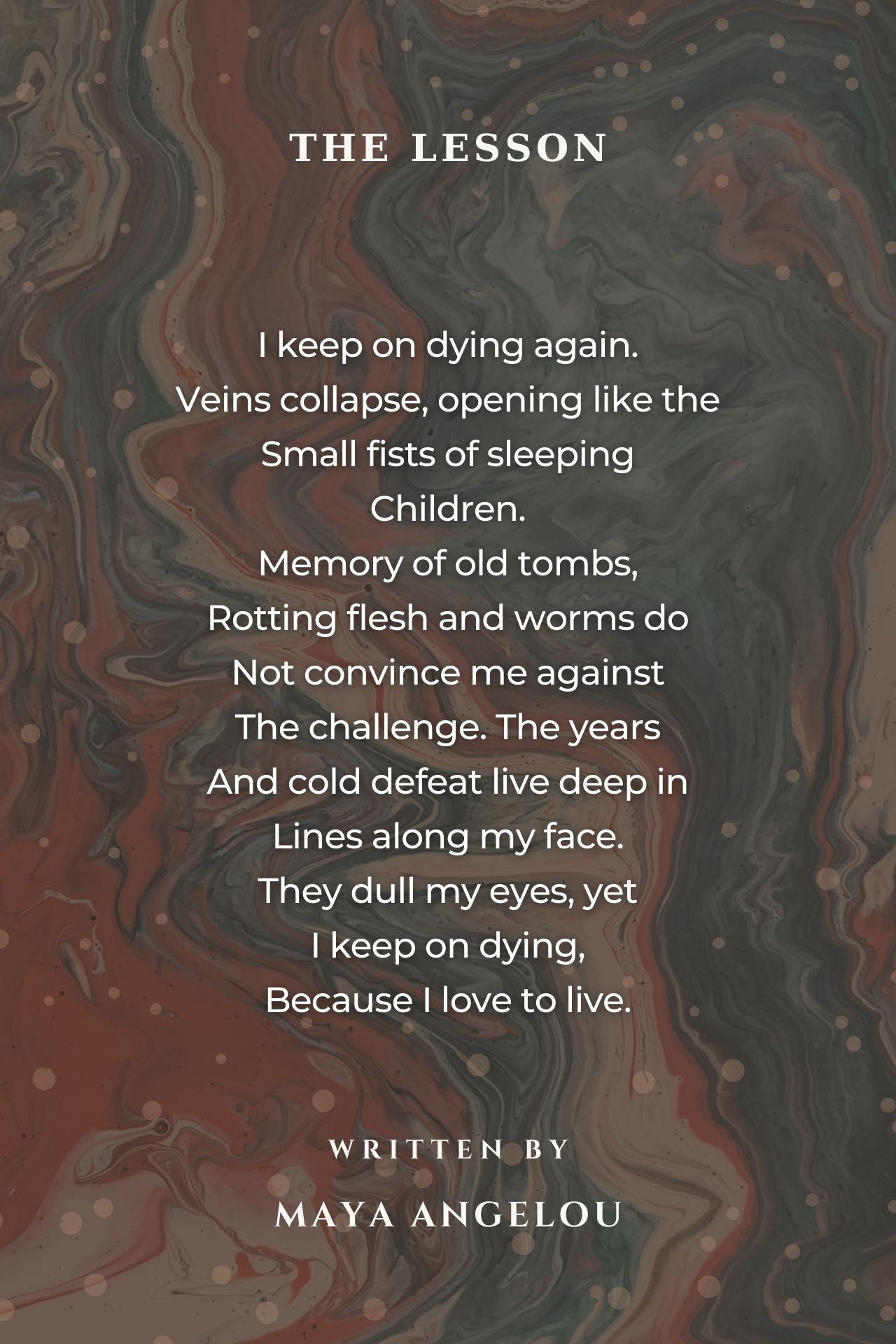
I keep on dying again.
Veins collapse, opening like the
Small fists of sleeping
Children.
Memory of old tombs,
Rotting flesh and worms do
Not convince me against
The challenge. The years
And cold defeat live deep in
Lines along my face.
They dull my eyes, yet
I keep on dying,
Because I love to live.
Heavenly cursed and heavily sinned I No more i like to add them, so, I want to die And I want to become a holy ghost Whom the people would like the most. Like the retreating soldiers I like to come back To my own permanent and eternal home You may call it a suicide or martyrdom.
In my real home I see the news Coming from the lipstick coated lips In the television of my molten death People are sobbing with a heavy breath. The atmosphere is heavy and they feel the pain This thrills me and gives a feeling of gain.
The only son of my father The only darling of my mother Fainted repeatedly on the cushion Peal like tear drops coming from my beloved son, Friends and relatives express grief in the community hall, All these excite me and I sought to say” I love you all.”
For the first time in my life in my last ritual I listen From those men that I was really a very very good man. In such intense atmosphere of gloom and sad My heart cheers and I become too much glad.
Maya Angelou’s “On The Pulse Of Morning” calls for unity and awakening amidst historical struggles. Nature—symbolized by the rock, river, and tree—invites humanity to confront the past, embrace peace, and strive for new beginnings. It emphasizes courage, hope, and the interconnectedness of all people as they seek a brighter future together.
Million Man March Poem by Maya Angelou The night has been long,The wound has been deep,The pit has been dark,And the walls have been steep.Under a dead blue sky on a distant beach,I was dragged by my braids just beyond your reach.Your hands were tied, your mouth was bound,You couldn’t even call out my name.You…
Maya Angelou’s “Weekend Glory” captures the essence of life for working-class individuals who enjoy their weekends despite societal judgments. The speaker finds joy in simple pleasures, prioritizing self-care and socializing over materialism, while emphasizing the importance of hard work and resilience. Life may not be perfect, but it is fulfilling.
Maya Angelou’s poem expresses the cycle of life and death through vivid imagery of decay and resilience. Despite confronting defeat and the passage of time, the speaker’s passion for living prevails, embodying the struggle between mortality and the enduring spirit of love for life.
I Want To Die Poem by Abdul Wahab Heavenly cursed and heavily sinned I No more i like to add them, so, I want to die And I want to become a holy ghost Whom the people would like the most. Like the retreating soldiers I like to come back To my own permanent and…
The dark wings of night enfolded the city upon which Nature had spread a pure white garment of snow; and men deserted the streets for their houses in search of warmth, while the north wind probed in contemplation of laying waste the gardens.
A Poet's Death Is His Life Iv Poem by Kahlil Gibran
The dark wings of night enfolded the city upon which Nature had spread a pure white garment of snow; and men deserted the streets for their houses in search of warmth, while the north wind probed in contemplation of laying waste the gardens. There in the suburb stood an old hut heavily laden with snow and on the verge of falling. In a dark recess of that hovel was a poor bed in which a dying youth was lying, staring at the dim light of his oil lamp, made to flicker by the entering winds. He a man in the spring of life who foresaw fully that the peaceful hour of freeing himself from the clutches of life was fast nearing. He was awaiting Death's visit gratefully, and upon his pale face appeared the dawn of hope; and on his lops a sorrowful smile; and in his eyes forgiveness.
He was poet perishing from hunger in the city of living rich. He was placed in the earthly world to enliven the heart of man with his beautiful and profound sayings. He as noble soul, sent by the Goddess of Understanding to soothe and make gentle the human spirit. But alas! He gladly bade the cold earth farewell without receiving a smile from its strange occupants.
He was breathing his last and had no one at his bedside save the oil lamp, his only companion, and some parchments upon which he had inscribed his heart's feeling. As he salvaged the remnants of his withering strength he lifted his hands heavenward; he moved his eyes hopelessly, as if wanting to penetrate the ceiling in order to see the stars from behind the veil clouds.
And he said, 'Come, oh beautiful Death; my soul is longing for you. Come close to me and unfasten the irons life, for I am weary of dragging them. Come, oh sweet Death, and deliver me from my neighbors who looked upon me as a stranger because I interpret to them the language of the angels. Hurry, oh peaceful Death, and carry me from these multitudes who left me in the dark corner of oblivion because I do not bleed the weak as they do. Come, oh gentle Death, and enfold me under your white wings, for my fellowmen are not in want of me. Embrace me, oh Death, full of love and mercy; let your lips touch my lips which never tasted a mother's kiss, not touched a sister's cheeks, not caresses a sweetheart's fingertips. Come and take me, by beloved Death.'
Then, at the bedside of the dying poet appeared an angel who possessed a supernatural and divine beauty, holding in her hand a wreath of lilies. She embraced him and closed his eyes so he could see no more, except with the eye of his spirit. She impressed a deep and long and gently withdrawn kiss that left and eternal smile of fulfillment upon his lips. Then the hovel became empty and nothing was lest save parchments and papers which the poet had strewn with bitter futility.
Hundreds of years later, when the people of the city arose from the diseases slumber of ignorance and saw the dawn of knowledge, they erected a monument in the most beautiful garden of the city and celebrated a feast every year in honor of that poet, whose writings had freed them. Oh, how cruel is man's ignorance!
Dive into captivating worlds, engage in thought-provoking discussions, and connect with fellow bookworms who share your passion for literature. Whether you're an avid reader, a casual browser, or someone looking to explore new genres, there's a place for you here amidst the emerald pages of our virtual library. #emeraldbookclub#bookstagram#book#bookworm#booknerd#booklover#booklovers#bookaddict