Passing Time
Passing Time Poem by Maya Angelou
Your skin like dawn
Mine like musk
One paints the beginning
of a certain end.
The other, the end of a
sure beginning.

Your skin like dawn
Mine like musk
One paints the beginning
of a certain end.
The other, the end of a
sure beginning.
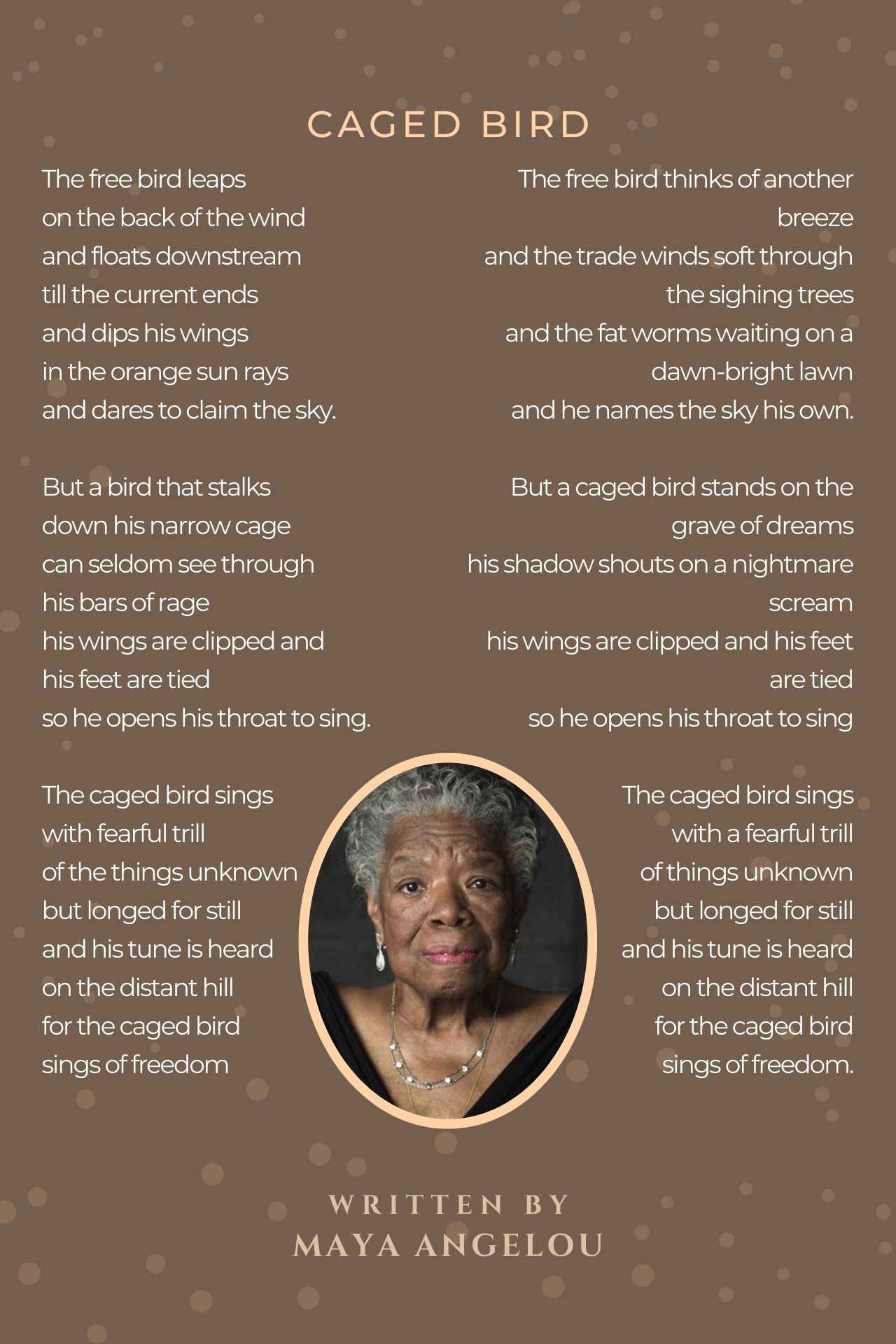
The free bird leaps
on the back of the wind
and floats downstream
till the current ends
and dips his wings
in the orange sun rays
and dares to claim the sky.
But a bird that stalks
down his narrow cage
can seldom see through
his bars of rage
his wings are clipped and
his feet are tied
so he opens his throat to sing.
The caged bird sings
with fearful trill
of the things unknown
but longed for still
and his tune is heard
on the distant hill
for the caged bird
sings of freedom
The free bird thinks of another breeze
and the trade winds soft through the sighing trees
and the fat worms waiting on a dawn-bright lawn
and he names the sky his own.
But a caged bird stands on the grave of dreams
his shadow shouts on a nightmare scream
his wings are clipped and his feet are tied
so he opens his throat to sing
The caged bird sings
with a fearful trill
of things unknown
but longed for still
and his tune is heard
on the distant hill
for the caged bird
sings of freedom.
By Maya Angelou
You may write me down in history
With your bitter, twisted lies,
You may trod me in the very dirt
But still, like dust, I'll rise.
Does my sassiness upset you?
Why are you beset with gloom?
’Cause I walk like I've got oil wells
Pumping in my living room.
Just like moons and like suns,
With the certainty of tides,
Just like hopes springing high,
Still I'll rise.
Did you want to see me broken?
Bowed head and lowered eyes?
Shoulders falling down like teardrops,
Weakened by my soulful cries?
Does my haughtiness offend you?
Don't you take it awful hard
’Cause I laugh like I've got gold mines
Diggin’ in my own backyard.
You may shoot me with your words,
You may cut me with your eyes,
You may kill me with your hatefulness,
But still, like air, I’ll rise.
Does my sexiness upset you?
Does it come as a surprise
That I dance like I've got diamonds
At the meeting of my thighs?
Out of the huts of history’s shame
I rise
Up from a past that’s rooted in pain
I rise
I'm a black ocean, leaping and wide,
Welling and swelling I bear in the tide.
Leaving behind nights of terror and fear
I rise
Into a daybreak that’s wondrously clear
I rise
Bringing the gifts that my ancestors gave,
I am the dream and the hope of the slave.
I rise
I rise
I rise.

Maya Angelou was an American memoirist, essayist, poet, and civil rights activist. She published seven autobiographies, three books of essays, several books of poetry, and is credited with a list of plays, movies, and television shows spanning over 50 years

not clear and seeming to have two opposing meanings, or confusing and able to be understood in two different ways.
My Partners response to contributing an equivalent amount for our bills was equivocal
"of doubtful signification, capable of being understood in different senses," c. 1600, with -al (1) + Late Latin aequivocus "of identical sound, of equal voice, of equal significance, ambiguous, of like sound," past participle of aequivocare. This is from aequus "equal" (see equal (adj.)) + vocare "to call," which is related to vox (genitive vocis) "voice" (from PIE root *wekw- "to speak").
Earlier in same sense was equivoque (late 14c.). Its opposite is univocal. Related: Equivocally (1570s).
This word is perfect for many scenarios in life that are vague or are not clear. It applies to many situations where clarity is not key. Examples are Relationships, Future, lottery, Unaccountability and of course our British Weather.
Be part of Vocabulary Tuesdays at Emerald Book Club, where we explore new words, sharpen our language skills, and connect through the magic of expression.
Death Poem by Brandi Young
Death is forever
So don't flirt with suicide
Death is painful
Stay away from knives
Death is not for lovers
So don't lie
Death is not for me
So don't even try
Death is clever
So be careful
Death is never fun
Stay away from strangers
Death is never pleasing
So don't get caught up in the hype
Death is never fair
So get use to it
Death is always occurring
So don't ignore it
Death is never what you expected
Sorry but it has to happen
Death is not for you
Please don't give up
Death is forever
Don't forget it
Maya Angelou's poem "Passing Time" contrasts two types of skin, representing different stages of existence. The imagery of dawn and musk symbolizes the beginning and end of life cycles. This interplay highlights the transient nature of time and the connections between beginnings and conclusions in human experience.
Maya Angelou's poem "Caged Bird" contrasts the lives of a free bird and a caged bird. The free bird enjoys liberty and explores the skies, while the caged bird, burdened by constraints, sings of yearning for freedom. Despite its confinement, the caged bird expresses hope through its song.
Still I Rise by Maya Angelou
(adjective) primarily means open to more than one interpretation or of an uncertain nature. It can apply to words, statements, actions, or results.
Death Poem by Brandi Young Death is forever So don't flirt with suicide Death is painful Stay away from knives
And Death Shall Have No Dominion by Dylan Thomas And death shall have no dominion. Dead man naked they shall be one With the man in the wind and the west moon; When their bones are picked clean and the clean bones gone, They shall have stars at elbow and foot; Though they go mad…
And Death Shall Have No Dominion by Dylan Thomas
And death shall have no dominion.
Dead man naked they shall be one
With the man in the wind and the west moon;
When their bones are picked clean and the clean bones gone,
They shall have stars at elbow and foot;
Though they go mad they shall be sane,
Though they sink through the sea they shall rise again;
Though lovers be lost love shall not;
And death shall have no dominion.
And death shall have no dominion.
Under the windings of the sea
They lying long shall not die windily;
Twisting on racks when sinews give way,
Strapped to a wheel, yet they shall not break;
Faith in their hands shall snap in two,
And the unicorn evils run them through;
Split all ends up they shan't crack;
And death shall have no dominion.
And death shall have no dominion.
No more may gulls cry at their ears
Or waves break loud on the seashores;
Where blew a flower may a flower no more
Lift its head to the blows of the rain;
Though they be mad and dead as nails,
Heads of the characters hammer through daisies;
Break in the sun till the sun breaks down,
And death shall have no dominion.
 Magic Shadow USB Air Humidifier For Home With Projection Night Lights Ultrasonic Car Mist Maker Mini Office Air Purifier
Price range: £6.38 through £35.85
Magic Shadow USB Air Humidifier For Home With Projection Night Lights Ultrasonic Car Mist Maker Mini Office Air Purifier
Price range: £6.38 through £35.85
 Turmeric & Ginger Gummies 120ct- Joint Support, Immune Boost, Vegan Friendly
£50.28
Turmeric & Ginger Gummies 120ct- Joint Support, Immune Boost, Vegan Friendly
£50.28
 Girls' Thickened Hand Books With Locks Laptops With Locks
Price range: £15.02 through £15.32
Girls' Thickened Hand Books With Locks Laptops With Locks
Price range: £15.02 through £15.32
 Stacked Books Lamp Nightstand Desk Lamps Resin Handicraft Stacked Books Light Stained Glass Table Desk Reading Light Decorative
Price range: £24.31 through £95.76
Stacked Books Lamp Nightstand Desk Lamps Resin Handicraft Stacked Books Light Stained Glass Table Desk Reading Light Decorative
Price range: £24.31 through £95.76
 Home Creative Books Acrylic Vase Decoration
Price range: £52.74 through £218.52
Home Creative Books Acrylic Vase Decoration
Price range: £52.74 through £218.52

